January 11, 2026
iso 27001 gap assessmentiso 27001 complianceinformation securityisms audit
Your Practical Guide to an ISO 27001 Gap Assessment
Master your ISO 27001 gap assessment with this practical guide. Learn to define scope, evaluate controls, and build a strategic remediation roadmap.
21 min readAI Gap Analysis
An ISO 27001 gap assessment is your organization's reality check. It's a deep dive that meticulously compares your current information security setup against the full list of requirements in the ISO 27001 standard. Think of it as the essential first step that uncovers every shortfall, big or small, and gives you a clear, actionable roadmap for getting certified. Skipping it is like trying to navigate a cross-country road trip without a map—you’ll eventually run into costly, frustrating surprises.
Why a Gap Assessment Is Your First Strategic Move
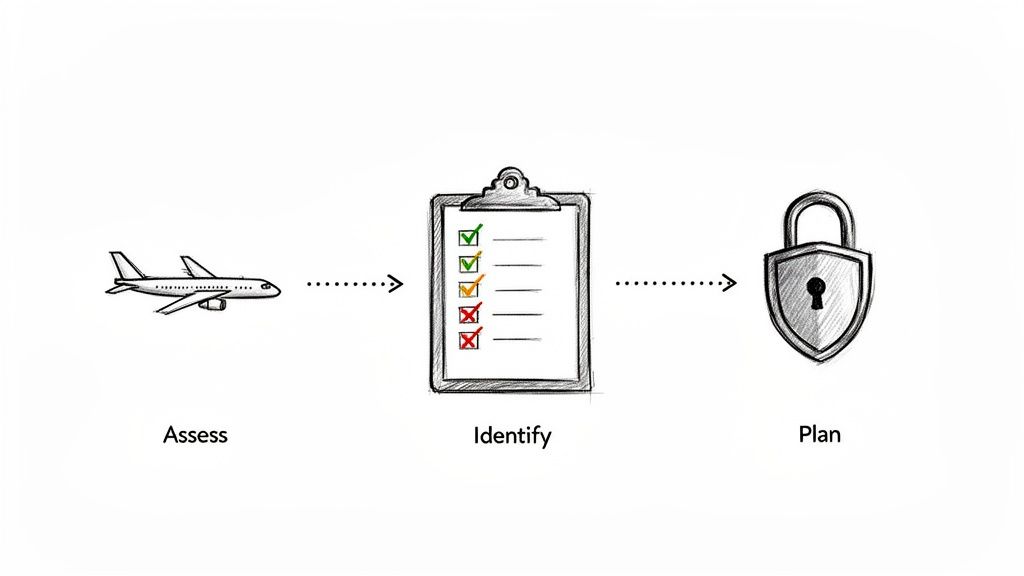
I always tell my clients to think of the gap assessment as the pre-flight check for their entire security program. Sure, it might feel like just another task on the long pre-audit checklist, but it’s the foundational diagnostic that makes the difference between a smooth certification journey and one bogged down by rework and unexpected costs. It gives you an evidence-based snapshot of your security posture, showing you exactly where you stand against the standard.
This process is far more than just ticking boxes. It’s a strategic exercise designed to unearth hidden vulnerabilities, align your security efforts with real business goals, and build a practical plan for your Information Security Management System (ISMS).
Uncovering Your Security Blind Spots
Without a formal gap assessment, it's easy for organizations to operate with a false sense of security. They might have a rock-solid firewall but completely neglect critical internal processes like employee offboarding or have a non-existent vendor risk management program. The assessment forces you to methodically review every single control, ensuring nothing gets missed.
I've seen this happen firsthand. A fast-growing SaaS company was convinced its developer-led security practices were top-notch. But a gap assessment revealed they had no formal documentation for access control reviews and their incident response procedures were just tribal knowledge. Both are instant audit failures.
A well-executed gap assessment is what turns abstract compliance requirements into a concrete project plan. It pinpoints the exact policies, procedures, and technical controls you need to build, saving you an incredible amount of time and resources by focusing effort where it's actually needed.
From Niche Standard to Business Prerequisite
The importance of starting with a gap assessment has skyrocketed. Between 2013 and 2023, ISO 27001 went from a niche certification to a baseline requirement for doing business, especially for B2B SaaS companies and anyone in a regulated industry. Global ISO 27001 certifications blew past 58,000 organizations worldwide by the early 2020s, with growth rates hitting around 20% annually as cloud adoption and stricter regulations took hold. This intense audit landscape makes a thorough gap assessment a strategic necessity, not just a nice-to-have. You can explore more insights on how the audit landscape has changed for modern compliance teams.
When it's all said and done, the assessment delivers the crucial benefits you need for a successful certification push:
- Clarity and Focus: It completely eliminates guesswork by handing you a detailed to-do list of every non-compliant area.
- Budgetary Precision: It helps you accurately forecast the time, technology, and people needed to fix the gaps. No more surprise budget requests.
- Stakeholder Alignment: The final report is a powerful tool for getting leadership on board and securing the resources you need to succeed.
By investing in this initial diagnostic, you're not just checking a box—you're laying a solid foundation that turns the daunting challenge of ISO 27001 certification into a manageable, well-structured project.
Defining the Scope of Your Information Security Program
Getting the scope of your Information Security Management System (ISMS) right is arguably the most critical decision you'll make on your ISO 27001 journey. I’ve seen this go wrong in two ways, and neither is pretty. You either try to boil the ocean with a scope that’s far too broad, or you draw the lines too tight, leave critical assets unprotected, and fail your audit.
Your scope is the official boundary line for your ISMS. It clearly states what parts of your organization—the people, processes, technology, and information assets—are being protected. This isn't just a casual exercise; it’s a formal requirement that dictates which Annex A controls will apply to your business and, therefore, what you’ll be assessing in your ISO 27001 gap assessment.
A well-defined scope brings much-needed clarity. It draws a clear line in the sand, telling everyone—from auditors to your own team—exactly what's "in" and what's "out." Without this boundary, your assessment can quickly devolve into a chaotic, never-ending hunt for evidence across the entire company.
People, Processes, and Technology
To build a scope that’s both practical and defensible, you have to dig into the core components of your operations. This means asking some pointed questions to figure out where your most valuable information actually lives and how it moves around.
Start with the key stakeholders. Clause 5.1 of ISO 27001 hammers home the need for leadership commitment, and this is where it truly begins. Your leadership team has to be in on these initial conversations to make sure the ISMS actually supports where the business is headed.
Here are the kinds of questions I always start with:
- Information Assets: What are the crown jewels? We're talking customer data, intellectual property, financial records, or employee PII. What information would be catastrophic if it were compromised?
- People: Which departments, teams, or even specific roles are creating, accessing, or managing this critical information?
- Technology: What systems, apps, databases, and network infrastructure are involved? Where does the data sit?
- Locations: Are we talking about physical offices? Specific data centers? A cloud environment?
- Third Parties: Do any key vendors or partners have access to our sensitive data or systems? They need to be considered.
Real-World Scoping Examples
The "right" scope is completely unique to your business model. There is no one-size-fits-all answer here, which is why putting in the thought upfront is so crucial.
I worked with a B2B SaaS company that narrowly defined its scope to cover only its cloud production environment. That included their AWS infrastructure, the dev team maintaining the platform, customer support, and the data flowing between them. Their corporate IT network? Explicitly excluded, because it didn't handle sensitive customer data.
On the other hand, a manufacturing firm I advised was obsessed with protecting its intellectual property. Their ISMS scope was built around the Research & Development department. It covered the R&D labs, the engineers, their specialized design software, and the secure servers where proprietary blueprints were stored.
For a more detailed look at how this fits into the larger picture, our guide on the overall gap assessment process offers a great framework.
The goal of scoping isn't to include everything. It's to create a logical, defensible boundary around the parts of your business that carry the highest information security risk. A narrow, well-defined scope is almost always more effective—and more manageable—than a broad, vague one.
Building Your Scope Statement
Once you've done the legwork, you're ready to draft your official ISMS scope statement. This document needs to be clear, concise, and leave no room for interpretation. It will become a cornerstone of your ISMS and one of the first things your auditors ask to see.
An effective scope statement usually spells out a few key things:
- Organizational Units: The specific departments or teams, like "The Software Development and Customer Support departments."
- Physical Locations: The offices or data centers covered, such as "...operating out of the London headquarters and the Dublin satellite office."
- Key Activities: The core business processes in scope, for instance, "...in support of the design, development, and delivery of the 'Product X' SaaS platform."
Nailing the scope from the very beginning sets you up for a much smoother gap assessment and, ultimately, an easier path to certification. It focuses your resources, clarifies who's responsible for what, and gives you a rock-solid foundation for your Statement of Applicability (SoA).
Mapping Your Current Controls to Annex A
Alright, with your scope locked in, it’s time to get into the weeds of the ISO 27001 gap assessment. This is where we shift from high-level planning to the hands-on work of comparing what you actually do against the 93 security controls listed in Annex A. It's a meticulous process of collecting evidence, talking to people, and making objective evaluations.
The core question you're trying to answer for every single control is simple: "Do we do this, and more importantly, can we prove it?" That proof is everything. An auditor won't just take your word for it—they need to see tangible evidence, whether that’s a documented policy, a system log, or meeting minutes.
The Workflow of Control Assessment
To keep this from becoming a chaotic mess, I always recommend splitting the process into two distinct phases: evidence collection and then evaluation. Trying to do both at once gets confusing and you risk making snap judgments without all the facts.
Your focus will be on gathering two main types of evidence:
- Documentation: These are your formal, written rules. Think of your Information Security Policy, Access Control Policy, or your Incident Response Plan.
- Records: These are the breadcrumbs that prove you're following your own rules. This includes things like user access review logs, completed employee onboarding checklists, or change request tickets from your firewall management system.
The infographic below shows how the people, processes, and technology within your scope all come together to inform this assessment.
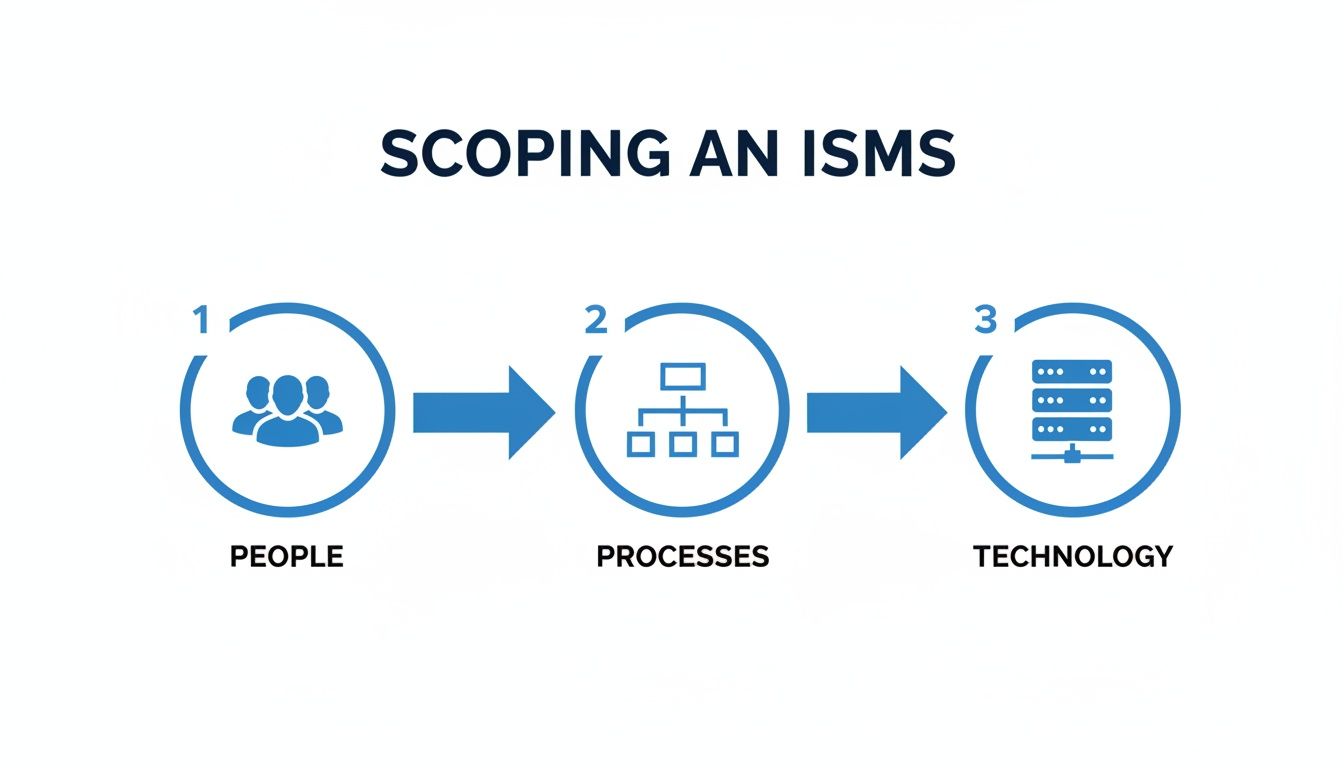
This illustrates a critical point: a thorough assessment isn't just about tech. You have to investigate how your teams work, the procedures they follow, and the systems they use.
A classic rookie mistake is to focus only on technical artifacts like firewall rules and server logs. While those are vital, they don't tell the whole story. You need to talk to the process owners. Interviewing a department head often provides invaluable context that a system log simply can't.
From Real-World Examples to Nuanced Scoring
Let’s get practical. Say you're assessing Annex A control 5.10 - Acceptable use of information and other associated assets. A simple "yes" or "no" checkbox just won't cut it. You have to dig in.
Here’s what that really looks like in practice:
- Collect Evidence: First, you’d request the company's Acceptable Use Policy (AUP). Next, you’d ask HR for proof that new hires actually read and sign this policy during their onboarding.
- Conduct Interviews: You might then sit down with the IT Manager to understand how they monitor for AUP violations and what happens when someone breaks the rules.
- Evaluate and Score: Finally, you bring it all together. Is there a documented policy? Is it enforced consistently? Is there a process for reviewing and updating it?
This is where moving beyond a simple checklist to a maturity scale becomes a game-changer. Instead of a binary compliant/non-compliant, a 0-5 scale gives you a much richer understanding of where you truly stand:
- 0: Non-Existent (No control is in place)
- 1: Initial (The control is ad-hoc, reactive, and undocumented)
- 2: Developing (A process is defined but isn't followed consistently)
- 3: Defined (The process is fully documented and formally approved)
- 4: Managed (The control is actively managed, measured, and reviewed)
- 5: Optimized (The control is continuously improved using metrics)
This granular scoring moves you from a simple to-do list to a data-driven view of your security posture. It also makes prioritizing remediation work much easier down the road. A control scoring a '1' is obviously a much higher priority than one scoring a '4'.
Understanding the Reality of Compliance Gaps
It’s crucial to set realistic expectations. From my experience, no organization is ever 100% compliant or 100% unprepared. The reality is almost always a messy middle ground, where many controls are partially implemented but lack the solid evidence to back them up.
A published case study of an ISO 27001 gap analysis across 133 controls found that only 56.4% were fully compliant on the first pass. The study also highlighted that management-related controls showed over 60% non-compliance, mostly due to a lack of formal, documented policies. You can explore the detailed findings of this ISO 27001 assessment to see how these gaps break down by category.
Don't be discouraged by finding gaps—that’s the entire point of the assessment. Every gap you find is an opportunity to strengthen your security before the official auditor shows up. The goal is progress, not perfection on day one.
The table below provides a few concrete examples of how this assessment looks in practice for specific Annex A controls.
Sample Annex A Control Assessment
| Annex A Control | Objective | Required Evidence (Examples) | Common Gaps Found |
|---|---|---|---|
| A.5.15 | Access control | Documented Access Control Policy; User access review logs (quarterly); Role-based access control matrix; Termination checklists showing access removal. | Access reviews are ad-hoc, not consistently logged; Former employees still have active accounts; "Privilege creep" where users accumulate unnecessary access over time. |
| A.5.23 | Info security in supplier relationships | Supplier security policy; Due diligence questionnaires for new vendors; Signed contracts with security clauses; Records of supplier security reviews. | No formal process for vetting new suppliers; Contracts lack specific security or data protection requirements; Supplier performance is never reviewed after onboarding. |
| A.8.26 | Network security | Network diagrams; Firewall rule sets and change logs; Documented network segregation policy; Results from vulnerability scans. | "Any/any" rules in firewalls; Lack of segmentation between production and development environments; No formal process for reviewing or approving firewall changes. |
This kind of detailed documentation is what turns a gap assessment from a simple check-the-box exercise into a strategic tool for improvement.
As you map controls, remember to look for overlaps with other frameworks, especially around data privacy. For instance, the access control principles in Annex A are directly related to data protection rules like GDPR. You can learn more about how these requirements intersect in our overview of privacy and compliance frameworks. An integrated approach can save a ton of time by identifying controls that satisfy multiple requirements at once. This mapping process is your chance to build a solid, evidence-backed foundation for your entire ISMS.
Turning Raw Data Into an Actionable Report
So, you've spent weeks, maybe months, deep in the trenches—mapping controls, chasing down evidence, and scoring your current state. What you're left with is a mountain of spreadsheets, notes, and raw data. In this form, it's not going to move the needle. The real magic of a great ISO 27001 gap assessment happens now: transforming all that information into a clear, compelling story that leadership can actually use.
A lot of auditors fall into the trap of just dumping all their findings into a massive document and calling it done. That’s a surefire way to get your report shelved. Your job is to tell a story with the data—a story about risk, yes, but also about opportunity and the exact steps needed to get secure and certified.
Crafting a Compelling Executive Summary
Let's be honest, your executive summary is probably the only thing senior leadership will read. It has to pack a punch. This isn't the place for technical jargon or a laundry list of every minor issue. It’s all about business impact.
Kick things off with the overall compliance score—that single number immediately frames the situation. Then, pivot straight to the biggest risks you found.
For example, instead of listing ten missing policies, frame it in terms of risk: "Our assessment revealed a 25% gap in management-related controls, largely due to a lack of formally documented policies. This creates significant operational risk and is a major roadblock to certification."
Make sure your summary nails these key points:
- The overall compliance percentage: A hard-hitting number to grab attention.
- Top 3-5 critical risk areas: The big, scary problems that need immediate focus.
- A high-level summary of required effort: A realistic sense of what's ahead (e.g., "Closing these gaps will require a concerted effort from IT and HR over the next six months.").
- The core recommendation: A clear call to action, which is usually to approve the remediation plan you're about to present.
Visualizing Gaps with a Heatmap
People process visuals far better than text. A simple heatmap can communicate the status of all 93 Annex A controls more effectively than a ten-page write-up. It gives everyone an instant, at-a-glance picture of the ISMS, immediately highlighting the problem spots.
I like to organize my heatmaps by the Annex A control domains (A.5 Organizational controls, A.6 People controls, etc.). Then, apply a simple color-coding system based on the scores you already assigned.
| Score | Status | Color | Description |
|---|---|---|---|
| 0-1 | Non-Compliant | Red | A major gap exists; we found no control or evidence. |
| 2-3 | Partially Compliant | Yellow | A control is in place but isn't working consistently or lacks proof. |
| 4-5 | Compliant | Green | The control is fully implemented, documented, and effective. |
This kind of visual is a game-changer in stakeholder meetings. It naturally steers the conversation toward the red and yellow boxes, making it much easier to get everyone to agree on where to start spending time and money.
Writing Evidence-Backed Remediation Recommendations
This is where the rubber meets the road—moving from diagnosis to prescription. Every single finding needs a specific, evidence-backed recommendation. Vague advice like “Improve access controls” is worthless because nobody can act on it.
Your recommendations have to be concrete and tied directly to the evidence you gathered. This isn't about opinions; it's about facts. This approach shuts down debate and makes the gap undeniable.
The gold standard for any finding is a three-part structure: state the control, describe the gap with specific evidence, and provide a crystal-clear recommendation. This leaves zero room for interpretation and hands the control owner a precise task.
Let’s look at the difference.
- Vague Finding: "A.5.15 Access control is not fully implemented."
- Actionable Finding: "A.5.15 is Partially Compliant. A review of server access logs on [Date] found three active user accounts for employees terminated over 60 days ago. The HR offboarding checklist was not followed, creating a direct security risk."
See how much more powerful that second one is? It's backed by proof. The recommendation that follows is equally sharp: "Update the offboarding procedure to mandate an IT sign-off verifying all system access is revoked within 24 hours of an employee's last day. Immediately conduct an audit to find and remove all other active accounts for former employees."
This level of detail is what separates an academic report from a practical project plan. It turns your ISO 27001 gap assessment into a true blueprint for success, guiding your team with clarity and purpose all the way to certification.
Building Your Remediation Roadmap
You've got the detailed gap report in your hands. The immediate urge is to dive right in and start fixing everything at once. That's a classic mistake, and it’s a fast track to burnout and project paralysis. Before you jump from analysis to action, you need to pause and be strategic. The best path forward is a structured remediation roadmap that prioritizes everything logically.
Think of your ISO 27001 gap assessment report as more than just a problem list—it’s the actual blueprint for your entire ISMS implementation. The real trick is to organize the findings so you can knock out the most critical issues first, getting the biggest security wins for your effort.
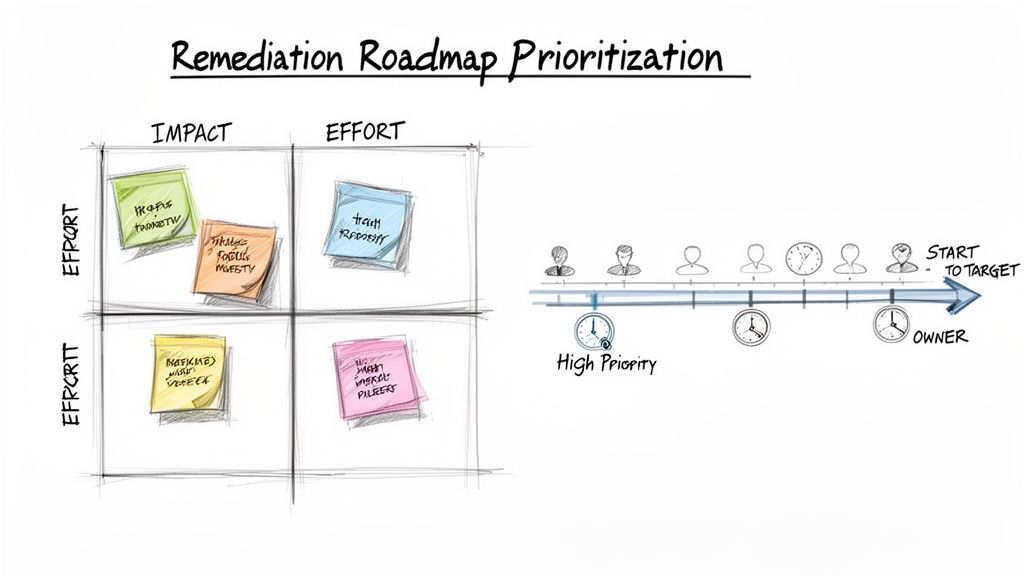
Prioritizing Gaps with an Impact-Effort Matrix
One of the most effective tools I've used for this is the simple impact-effort matrix. It’s a visual way to categorize every remediation task by asking two straightforward questions: What’s the risk or business impact of this gap? And how much effort will it actually take to fix it?
Going through this exercise forces you and your team to think critically about each finding. It stops people from just grabbing the easy, low-hanging fruit while high-risk vulnerabilities are left to linger.
- High Impact, Low Effort (Quick Wins): These are your absolute top priorities. A perfect example is enforcing multi-factor authentication (MFA) on all critical systems. The security payoff is massive, but the rollout is usually pretty straightforward.
- High Impact, High Effort (Major Projects): These are the big ones that need real planning. This could be something like implementing a full-blown supplier security review program from scratch or deploying a new endpoint detection and response (EDR) solution across the company.
- Low Impact, Low Effort (Fill-in Tasks): These are the gaps you can tackle when you have a bit of breathing room. Think about updating some minor policy wording or just formalizing a process that’s already happening informally.
- Low Impact, High Effort (Re-evaluate Later): These items should go straight to the back burner. Schedule them for a later date or, better yet, re-evaluate if they're truly necessary for your security posture right now.
When you plot every task on this matrix, the path forward becomes crystal clear. You can build a project plan that delivers immediate value while you steadily chip away at the larger, more complex initiatives.
The goal of a remediation roadmap isn’t to fix every single gap in one month. It’s to create a realistic, risk-based plan that shows continuous improvement to auditors and stakeholders. It proves you have a mature process for managing information security.
Assigning Ownership and Setting Timelines
Okay, priorities are set. Now, every single task needs two things: a designated owner and a realistic deadline. Ambiguity is the enemy here. Without clear accountability, important tasks will absolutely fall through the cracks. The "owner" is the one person responsible for driving that task to completion, even if they need to pull in others for help.
For instance:
- Task: Implement MFA on all administrator accounts.
- Owner: Head of IT
- Deadline: End of Q1
- Task: Draft and approve a formal Supplier Security Policy.
- Owner: Compliance Manager
- Deadline: End of Q2
This simple step transforms a static report into a living, breathing project plan. It spells out exactly who needs to do what by when, which is everything when it comes to tracking progress and keeping the project on track.
Securing Management Buy-In and Resources
This prioritized roadmap, complete with owners and timelines, is your best tool for getting management on board. You're not just showing them problems; you're presenting a clear, logical, and data-driven plan that proves you have the situation under control. This isn't some vague plea for "more security." It's a specific project proposal with a defined scope and measurable outcomes.
Presenting this plan completely changes the conversation with leadership. It shifts from, "We have problems," to, "Here are our specific problems, here is exactly how we will fix them, and here is what we need from you to make it happen." This structured approach builds confidence and makes it infinitely easier for executives to sign off on the budget and resources you need.
You can find more strategies for effective compliance management in our broader educational resources. At the end of the day, your gap assessment finds the problems, but it's the remediation roadmap that actually solves them.
Answering Your ISO 27001 Gap Assessment Questions
Even with the best playbook, you're going to have questions once you get started. It happens every time. Let’s tackle some of the most common ones we hear from teams who are new to the ISO 27001 process.
So, How Long Does This Actually Take?
This is always the first question, and the honest answer is, "it depends." But that's not very helpful, so let's put some real numbers on it. For a typical small or medium-sized business—say, under 100 employees with a pretty straightforward scope—you should budget for two to six weeks of dedicated work.
Of course, that timeline can shift. Here’s what can stretch it out:
- Company Complexity: The more departments, office locations, or tangled systems you have in scope, the longer it will take to gather all the necessary evidence. It just stands to reason.
- Who's Available: The biggest bottleneck is almost always the availability of your own team. If your lead engineers or HR manager are swamped, you'll be waiting on them for documents and answers, and the clock keeps ticking.
- Your Starting Point: Are you a company that already has a bunch of documented policies and procedures? Great, you're ahead of the game. If you're starting from a blank slate, expect the process to take longer.
A quick piece of advice: Don't optimize for speed here. The goal is to be thorough. If you rush the gap assessment, you're just setting yourself up for nasty surprises during the real audit. Take the time to do it right.
Can We Just Do This Ourselves?
Absolutely. Plenty of organizations run their own internal gap assessments, and it can be a great way to build up your team's compliance muscle. If you have people with audit or security experience on staff, you can definitely manage this in-house.
But there's a strong case for bringing in a third party. An external consultant has no skin in the game. They aren't swayed by internal politics and can give you an unvarnished, objective look at your security posture. They’ll spot gaps your own team might be blind to simply because they're too close to the work.
Plus, a seasoned consultant has seen it all. They know the common traps and understand exactly what auditors are trained to look for. That kind of insider knowledge can save you a ton of time and dramatically lower your risk of failing the Stage 1 audit. For most smaller companies, the all-in cost for ISO 27001 certification runs between $10,000 and $50,000. Investing a portion of that in expert help upfront is often money very well spent.
What Tools Should We Be Using?
You don't need to go out and buy a bunch of expensive software. Honestly, you can run a perfectly effective gap assessment using a well-organized spreadsheet. Just create a tracker with columns for each Annex A control, your assessment score, links to evidence, a description of the gap, and your plan to fix it.
That said, once you start juggling hundreds of pieces of evidence and multiple stakeholders, a spreadsheet can get unwieldy. This is where specialized GRC (Governance, Risk, and Compliance) platforms really shine. Tools like Vanta or Drata are built for this. They help automate evidence collection, manage your policy library, and give you a real-time dashboard of your progress. They create a central source of truth for your ISMS, which cuts down on the manual chaos, especially when it's time for the formal audit.
Ready to stop digging through documents and get straight to the findings? AI Gap Analysis uses AI to read your security documentation, map it directly to ISO 27001 controls, and generate evidence-linked answers in minutes. Get started with your free analysis credit today.